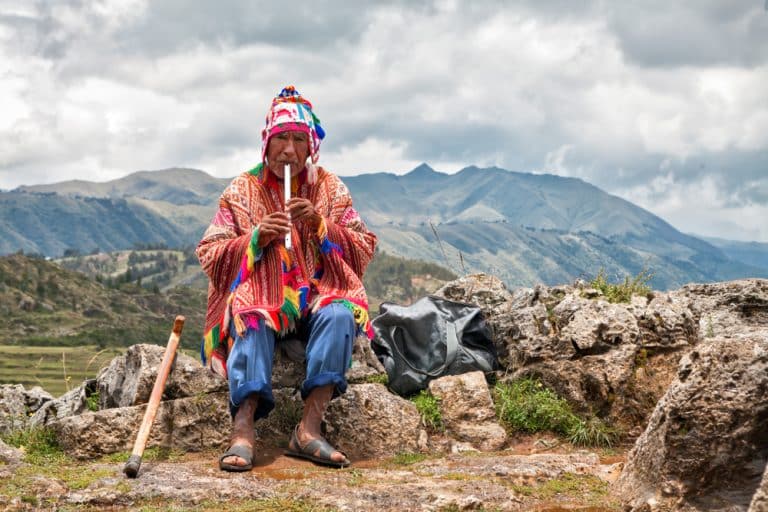
South American Peru offers travelers a multifaceted mix of grandiose landscapes that are interspersed with testimonies of long-gone advanced civilizations. In addition, there are lively metropolises to explore Peruvian city life. The population is very warm and hospitable. Due to the diversity of the country, a round trip is a good way to see and experience as much as possible. However, there are a few important things to keep in mind.
Organizational aspects for the success of the Peru round trip
German citizens do not need a visa for Peru if the planned stay does not last longer than three months. A passport that is valid for at least six months is required for entry. In this part of South America, the inhabitants speak the Spanish language, English is not so widely spoken. The Peruvian currency is called Nueva Sol and can be exchanged for euros in many places. When planning the round trip, the size of the country must be considered. Thus, the length of the coastline from the northern border with Ecuador to the southern end at the Chilean border is more than 3,300 km. Due to the large distances, it is a good idea to set a thematic focus for the round trip. These can be the following topics:
In the footsteps of the Incas
Trekking in the mountains
Discover historical treasures
Explore coasts and cities
The Peruvian landscapes and regions are extremely diverse, there is tropical rainforest, the high mountains of the Andes, extensive deserts and the coasts of the Pacific. To make the Peru round trip a complete success, organized tours with experienced tour guides and hiking guides are available.
Determine the type and period of the tour in Peru
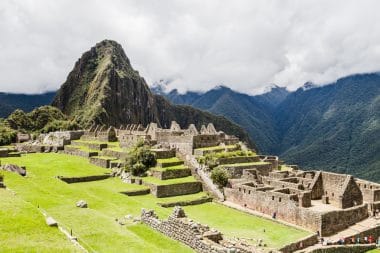
Machu Picchu, Image: Bluesnaps / shutterstoclk
Peru is the original empire of the Incas, as evidenced by numerous historical buildings and monuments such as Machu Pichu and Cusco. Many of the places are located high up in the mountains and are best explored on hikes. In general, trekking is an optimal method to discover the numerous treasures in Peru. The best months for a Peru round trip are from May to September, as this is the dry season. On the other hand, a lot of rain is to be expected in the autumn and winter months, which mainly falls in the Peruvian mountain landscape. On the Peruvian coastal region, the sun shines all year round and it is pleasantly warm. If you want to go all the way up into the mountains, you have to keep in mind that altitude sickness can occur there.
Hygiene and vaccination protection
In view of the Corona pandemic, there are also certain restrictions in Peru, but these can change daily. Therefore, holidaymakers should inform themselves sufficiently before starting their trip, for this purpose the Federal Foreign Office has all the necessary data and facts ready. Apart from Covid vaccination, no other vaccinations are required, but yellow fever and hepatitis A and B are recommended. In addition, the normal vaccinations should be refreshed if they were given some time ago. Tap water is not drinking water and should not be consumed.
Result
If you pay attention to the things mentioned, you can enjoy the Peru round trip with all your senses. In an organized group trip, possible problems can be avoided.
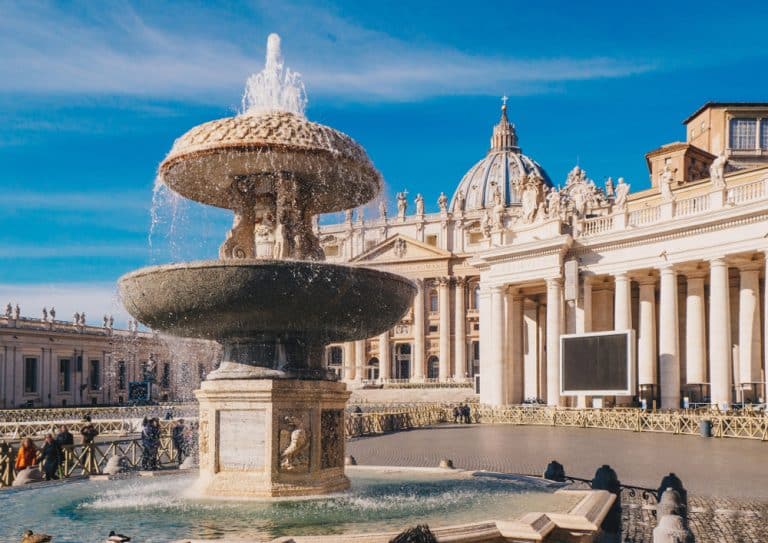
Vatican City is unique in many ways. Not only that the dwarf state, whose name would actually indicate more to be a city than a state, is the smallest state in the whole world with an area of only 0.44 square kilometers. It is also the only country that has made Latin its official language. In addition, no country in the world has fewer inhabitants than Vatican City. At the last official census in 2020, there were 932, but only 552 of them were considered citizens.
In addition, the national territory is not surrounded by a country, but only by a city, namely the Italian capital Rome. The Pope is the head of state of the dwarf state, which was built on the Vatican Hill, a 75-meter-high tuff hill. Vatican City is the only country in the world whose entire territory has been designated a UNESCO World Heritage Site. These include St. Peter’s Basilica and the Vatican Museums, which are not located in Rome, as many people believe, but in a completely different country than Italy.
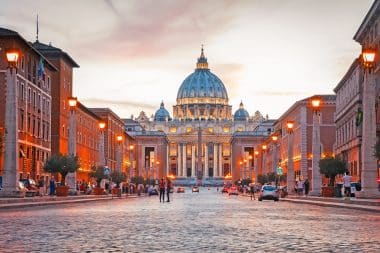
View of the illuminated St. Peter’s Basilica and Via della Conciliazione, Image: Pani Garmyder / shutterstock
The name St. Peter’s Basilica is only known in the German-speaking world. The Italian name San Pietro in Vaticano gives an indication of the location of the basilica. Anyone who visits St. Peter’s Basilica enters the territory of the Vatican. In addition to this outstanding fact, St. Peter’s Basilica impresses with its size. The floor area of the basilica is exactly 20,139 square meters. 20,000 people can be in the building at the same time.
Of course, not for sightseeing, but for the trade fair. If you want to take in the beauties of St. Peter’s Basilica, built between 1506 and 1626, then a visit during the viewing hours, when the streams of visitors are well channeled, is a good idea. Before you enter, you have to take a look at the dress code, because of course it is chaste in this Catholic church. In any case, the shoulders must be covered and it is best to wear long trousers or a skirt that reaches at least above the knees. Otherwise, the visit can also be denied by the staff. St. Peter’s Basilica is spanned by a striking main dome and ten small side domes, all of which can be viewed from the inside. In addition to the 778 columns, 395 statues and 44 altars are grouped under these domes. Under St. Peter’s Basilica lies the tomb of St. Peter.
In addition, there are 20 tombs and monuments of popes positioned within St. Peter’s Basilica. Taking a closer look at the interior, tourists quickly notice that a single visit to St. Peter’s Basilica will not be enough if you want to deal with all the art treasures. The domes, for example, and also the altarpieces are designed with mosaics. Anyone who has seen all the mosaics of St. Peter’s Basilica has seen a 10,000 square meter mosaic together.
The Vatican Museums with Sistine Chapel
Among other things, the Vatican Museums house most of St. Peter’s Basilica’s altarpieces. The so-called Papal Art Collection also contains a whole range of other important art treasures. Oriental antiquities from ancient Egypt and Assyria, Greco-Roman art from classical antiquity, Etruscan antiquities, early Christian and medieval art from the third to the 14th century, as well as works of art from the Renaissance to the present day. The exhibition is complemented by a well-stocked ethnological collection.
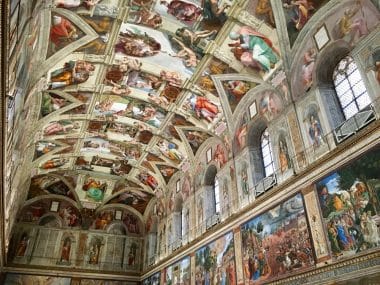
Sistine Chapel Vatican City, Image: amw213 / shutterstock
In addition, the Sistine Chapel, which is housed in the official residence of the Pope, the Apostolic Palace, is also part of the Vatican Museums. The Sistine Chapel is known for its outstanding murals depicting scenes from the life of Jesus. These include, among other things, a depiction of the Last Supper. Parts of the ceiling paintings of the Sistine Chapel show scenes from the Old Testament, which were often depicted in art and textbooks, or used, for example, for advertisements. For example, The Creation of Adam and The Fall of Man and the Expulsion from Paradise. Another part of the Vatican Museums area are the Vatican Courtyards. The courtyard of the Belvedere invites you to stroll between pines, pines, palms and cypresses. Together with the Cortile della Biblioteca, it frames the Vatican Library, which was established as early as 1475. Among other things, there are 150,000 extremely valuable manuscript volumes here.
Vatican City seen from above
Even if you may have to queue for a while, you should not miss the walk to the main dome of St. Peter’s Basilica. From there, visitors have a fantastic view over the entire Vatican and St. Peter’s Square in front of St. Peter’s Basilica. The view over the Italian capital Rome, which surrounds Vatican City, also extends far. If you are athletic, climb the 551 steps to the false roof on foot. All others can get here by elevator. However, it is really only possible to go all the way up on foot and there are still 320 steps of the ascent to the final viewing platform.
What else you should know about Vatican City
More important than anywhere else in the area is to behave appropriately in Vatican City on the one hand, but on the other hand to be aware that the crowds of people pouring into this holy place also attract a lot of dubious people. Pickpockets often try their luck in the confusing hustle and bustle, which is why you should take special care of your valuables here. By the way, if you need cash, you can also use an ATM in Vatican City, which guides you with Latin operating instructions.
South Africa owes its attractiveness to its scenic beauty, the breathtaking biodiversity of flora and fauna and, last but not least, the attitude to life of the local population, which can be felt in many places. The landscapes of South Africa have something for every type of holiday: from lonely sandy beaches and bays to lively stretches of beach, from the red, parched soils of the Kalahari to the lush green forests along the Garden Route, from Cape Town and Pretoria on the cold Atlantic to Durban on the warm Indian Ocean, from extreme heat in the Kaaro to cool temperatures on the high Drakensberg Mountains.
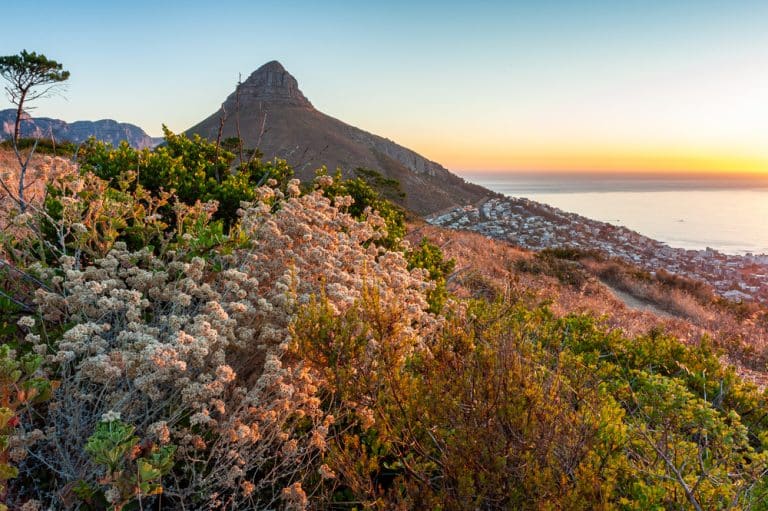
#Die diverse natural conditions of South Africa create habitats for an overabundance of plants and animals. There are 16,000 species of plants, around 300 different mammals and over 830 species of birds. Africa’s national flower is the protea, an evergreen shrub with large inflorescences that cannot be found anywhere else on earth. In South Africa , it exists in over 400 forms.
South Africa’s diversity of game reserves and national parks is the country’s main attraction, offering holidaymakers some of the continent’s most thrilling safari experiences. In the reserves, there are a wide variety of landscapes, from forests and deserts to coasts and mountains, which are home to every imaginable animal species. The so-called “Big Five” – elephant, rhinoceros, buffalo, lion and leopard – are at home in several reserves and can be observed and photographed by travellers. If you also want to see running ostriches, zebras, giraffes and wildebeests as well as cheetahs and lynxes or a herd of graceful antelopes in their natural habitat, a visit to a South African national park is worthwhile.
The world-famous “Kruger National Park”, which with an area of about 20,000 square meters is half the size of Switzerland , is one of the most popular holiday destinations in South Africa. From the dainty antelope species of the dikdiks, which is not even 50 cm tall, to the elephant colossus of 6 tons, many animals are at home here. The biodiversity is gigantic. The national park is home to around 150 species of mammals, 114 reptiles and over 500 species of birds. The 12 main camps with restaurants, shops and gas stations resemble small towns and ensure a pleasant stay of several days in the national park. Some of the most popular camps include Lower Sabie, Orpen, Letaba, Olifants, and Pretoriouskop.
During a car ride through the “Hluhluwe-iMfolozi Park”, one of the oldest African wildlife reserves, travellers can, with a bit of luck, discover the endangered white rhinoceros in addition to elephants, buffaloes, cheetahs, lions and wild dogs.
Lively South Africa
Cape Town
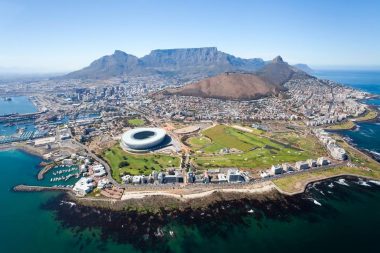
View of Cape Town, Image: michaeljung / shutterstock
Cape Town is one of the most beautiful cities in the world and therefore one of the most popular holiday destinations in South Africa. The oldest city in the country and the immediate surroundings offer visitors an interesting mix of colourful multiculturalism, recent history of the country, harbour feeling and shopping pleasure as well as spectacular natural formations. Founded in 1652 as a supply station for shipping, the city is located at the foot of the majestic Table Mountain. The old fort from 1666 is the oldest building in South Africa. In addition, there are a number of buildings in the Dutch colonial style to visit.
Cape Town’s landmark is the mighty Table Mountain, which travellers can easily reach by gondola. For all those who like it more sporty, about 300 hiking trails with different levels of difficulty lead from the valley station to the summit. Due to its location, about 1,500 different plants grow on the Table Mountain massif. All nature lovers can admire this extraordinary variety of plants in the Kirstenbosch National Botanical Garden. One of the most popular destinations in Cape Town is the notorious prison island of Robben Island, where Nelson Mandela was imprisoned until 1982. Other highlights include the lively entertainment and strolling district “V&A Waterfront” and an organized township tour. No one knows exactly how many people really live in the townships. For those who want to understand the history of South Africa, a visit to Soweto is a must on their trip.
Johannesburg and Pretoria
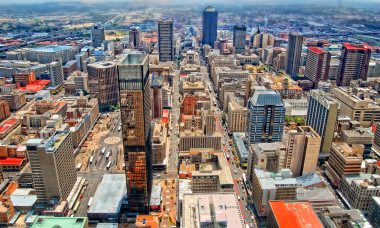
View of the Johannesburg skyline, Image: Nataly Reinch / shutterstock
The province of Gauteng, with the two metropolises of Johannesburg and Pretoria, which are only 50 kilometres apart, is a popular holiday destination for all travellers interested in history. Here you will find important testimonies to the very eventful history of the country. The Apartheid Museum in Johannesburg is one of the most interesting and provocative museums in the world. Other sights include the Nelson Mandela Bridge, Museum Africa and the reconstructed old gold mining town of Gold Reef City. South Africa’s capital Pretoria fascinates with magnificent avenues, imposing government buildings, historical sights and a variety of interesting museums. Highlights include the impressive Union Buildings complex, the Pretoria Art Museum and Church Square Park with the Palace of Justice and the Kruger Museum.
Sporty South Africa
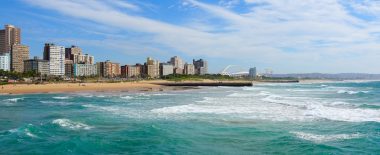
View of the “Golden Mile” of Durban, Image: Alexandre G. ROSA / shutterstock
In South Africa, there are no limits to active holidaymakers. With almost 3000 km of coastline, the country offers plenty of opportunities for all kinds of water sports. Although the Atlantic Ocean is too cold for swimming, there are also some magnificent beaches in the Cape region. From Cape Agulhas eastwards, the Indian Ocean with its warmer sea water invites you to swim and bathe. In the province of KwaZulu-Natal and especially on the Garden Route there are beautiful sandy beaches.
The city of Durban, with its wide sandy beaches and beautiful lakeside promenade, is a popular holiday destination for all swimmers and sun worshippers. The South African coast offers a diverse habitat for marine animals and is therefore a diver’s paradise. Dives to the coral gardens of Aliwal Shoal and Sodwana Bay in KwaZulu-Natal, to the kelp forests and wrecks around the cape, as well as whale watching, lagoon diving around Knysna are unique experiences. Brave divers can get up close and personal with great white sharks in a cage. South Africa is considered a surfing hotspot. The best surfing areas are the coasts of Jeffrey’s Bay and Durban.
On foot, by bike or on horseback, holidaymakers can explore the country. There are countless hiking routes. Going on a walking safari with an armed ranger in the “Kurger National Park” is exciting and an unforgettable adventure. There are various mountain bike trails throughout the country, even in some national parks. Riding enthusiasts will get their money’s worth on the beaches of the Cape Province and in the Drakensberg Mountains. With some local providers, you can also book horseback safaris in wildlife sanctuaries.
The sky-high Drak Mountains on the border with Lesotho are particularly popular with hiking enthusiasts. Here, sporting activity can be wonderfully combined with unique nature experiences. The “uKhahlamba-Drakensberg Park” comprises a total of 12 nature reserves with a total area of almost 2,500 square kilometres. During hikes through the fascinating natural landscape with imposing mountain giants over 3,000 m high, the second highest waterfall in the world, discreet mountain lakes, holidaymakers are offered magnificent views and even ancient cave paintings
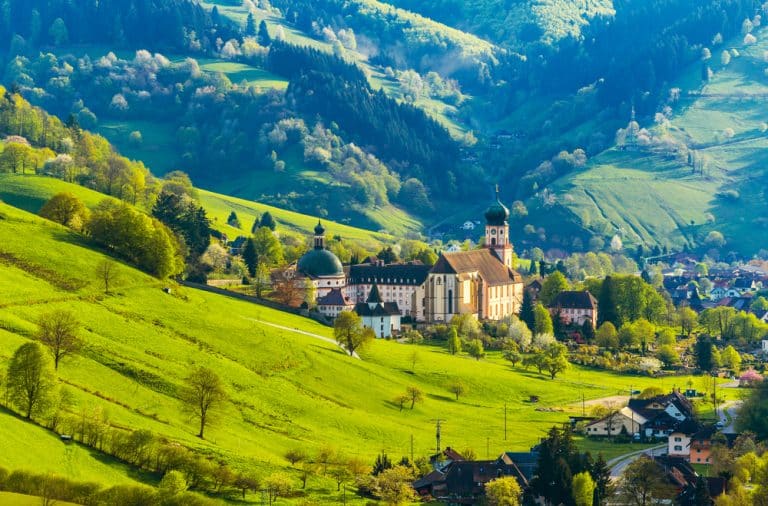
For some, the Black Forest may remind them of a fairytale landscape. The atmosphere in this low mountain range is above all quiet and tranquil. Tourists discover wooded heights and dreamy valley landscapes with waterfalls, rivers and numerous bathing lakes, an ideal destination for hiking enthusiasts. But winter sports fans will not miss out here either. On the Feldberg, and another 70 mountains of up to 1,493 meters altitude, you can ski in winter.
In addition, the region attracts with traditional handicrafts. Who doesn’t know the world-famous cuckoo clocks, which are still made in filigree handicraft in the Black Forest today? If you like sweets, you can’t get past the Black Forest cake, which was also invented here. The Black Forest is therefore a holiday region that promises relaxing holidays all year round. And if you like culture, this is the right place for you, because cities such as Freiburg im Breisgau, Baden-Baden or Villingen-Schwenningen have high-ranking art museums and first-class architectural sights.
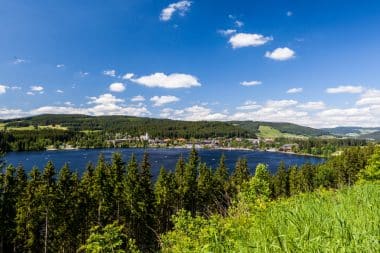
Titisee-Neustadt in the Black Forest, Image: Oscity / shutterstock
The Black Forest is one of the most popular hiking regions in all of Germany. The region is known for a wide network of hiking trails that meet all requirements. Multi-day hikes can be undertaken here just as well as day tours that are suitable for the whole family. The Black Forest-Swabian-Alb-Allgäu Trail, for example, is a 311-kilometer long-distance hiking trail that leads from Pforzheim through the northern Black Forest. In the southern Black Forest, the 1,415-metre-high Herzogenhorn beckons. The mountain is located on the grounds of the Feldberg nature reserve and can be climbed via a wide variety of well-signposted hiking routes. In good weather, you can see as far as the French Vosges from the summit.
If you are more in the mood for swimming, visit the Feldsee or the Titisee in summer. The Feldsee is the highest lake in Germany. It is located 1,109 meters above sea level. By car, you can get up to a maximum of four kilometers to it. The rest of the way you have to walk. On the other hand, the surrounding nature is picturesque and untouched. A walking and mountain biking route leads around the lake. Lake Titisee is located at an altitude of 845 metres and is particularly popular with families. Because the Titisee can be explored with pedal boats and excursion boats. Anglers also like to visit Lake Titisee, as it has a rich population of lake trout, eels, pike, zander and other lake fish.
Nearby is the Wutach Gorge, which is nicknamed the Grand Canyon of the Black Forest. On a 30-kilometre area, whitewater canoeists, hikers and nature lovers meet. About 2,800 plant species can be discovered here, including more than 40 different species of orchids. The gorge also attracts bird and butterfly watchers. Furthermore, the many waterfalls and shell limestone walls of the Wutach Gorge are fascinating.
Snow adventure in the Black Forest
With the Feldberg, Hinterzarten and Todtnau, the Black Forest has several winter sports centres to offer, where World Cup competitions in ski jumping, cross-country skiing and alpine skiing take place. However, the vast majority of winter sports enthusiasts on site are amateurs. Many hiking routes are also accessible as winter hiking routes. Some are also converted into toboggan runs after the first snowfall and enable rapid toboggan runs. If you want, you can snowshoe around the Feldberg and Todtmoss. On every corner there are also wellness offers such as saunas and thermal and mineral baths, where you can relax after icy snow days. The Christmas markets are romantic. Almost every place in the Black Forest has its own. Covered in deep snow, they attract visitors with the scent of mulled wine, gingerbread and regional handicrafts. In addition to the obligatory cuckoo clocks, there are also handmade Christmas tree baubles from local glassblowing workshops to buy, for example.
Popular city trips to the Black Forest
Architecture and culture in Freiburg im Breisgau
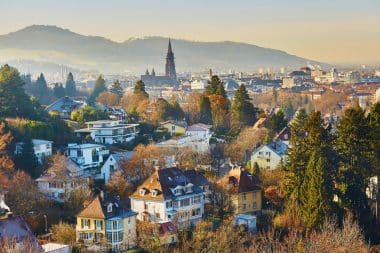
Panoramic view of Freiburg, Image: Sina Ettmer Photography / shutterstock
Freiburg im Breisgau is a real tourist magnet. This is not surprising once you have taken a walk through the historic old town. Narrow alleys are lined with traditional half-timbered houses, while the Freiburger Bächle makes its way through the city. In the Middle Ages, the artificially created stream served as a fire water supply.
Today he seems mainly charming. You should definitely visit the Freiburg Cathedral and the Münsterplatz. The cathedral was built between 1200 and 1513 in Romanesque, Gothic and late Gothic styles. The stained glass windows of the church building are particularly beautiful to look at. Münsterplatz is home to some medieval architectural beauties such as the Alte Wache and the Historisches Kaufhaus from 1520. With the Martinstor and the Schwabentor, there are still two magnificent gates of the former city fortifications that have been preserved. Freiburg is also known as a theater city. There are more than ten professional stages in Freiburg. These are supplemented by countless improv theatre and amateur play groups.
Baden-Baden as a city of art
The old residential city of Baden-Baden became famous above all for its casino and its tradition as a spa town. But there are many more highlights to discover here. After all, the museums in Baden-Baden attract art lovers from all over the world. In the Staatliche Kunsthalle, temporary exhibitions are shown that deal with the current trends in contemporary art. The Museum Frieder Burda exhibits paintings, sculptures and graphics by renowned artists of the 20. and 21st century. Among them are works of art by August Macke, Mark Rothko, Pablo Picasso and Georg Baselitz.
Clock tradition in Villingen-Schwenningen
The Black Forest is not only known for its precise clock craftsmanship because of the cuckoo clock. High-quality watches have been manufactured in the region for centuries. In the Schwenningen Museum of Local History and Clocks, you can follow how Black Forest clocks are built in a traditional watch workshop.
On the map, the Kingdom of Spain spreads out like a bullskin between neighboring France and Portugal. With its thousands of kilometres of coastline, the country is one of the most popular travel destinations. But beyond the bathing fun in the sunshine and the party hustle and bustle in the tourist hotspots, the big country on the Iberian Peninsula has much more to offer: the endless Meseta in the center, the massif of the Sierra Nevada, a unique culture and hospitable people.
It is probably due to the mild climate that life in Spain takes place much more outdoors than behind closed doors. Popular meeting places are the small bar or the next plaza, where you can enjoy delicious tapas with wine or sherry. Because fried small fish, homemade croquettes, small, fresh salads and pickled olives are always worth a sin.
So the time is evaluated differently in this country, impatience and hectic are foreign to most Spaniards – and so the endless number of Spanish sights only become a sightseeing delight with the necessary leisure.
From the green north to the hot south
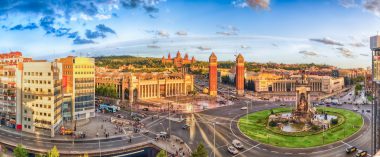
The Place d’Espanya in Barcelona, Image: Marco Rubino / shutterstock
The north of the country does not correspond to the cliché of heat-shimmering Spain at all: Refreshing rain from the Atlantic allows the famous wine of La Rioja to thrive magnificently in the hinterland. To the northwest runs the centuries-old route of the pilgrims of St. James, along the way of which there are ravishingly simple Romanesque church buildings and particularly magnificent Gothic cathedrals. The Guggenheim Museum in Bilbao , on the other hand, provides a fascinating counterpoint.
Catalonia in Spain’s northeast attracts visitors to the Costa Brava and the Costa Daurada with its dream beaches and rocky bays. The most dazzling personality in Catalonia is considered to be the eccentric Salvador Dalí, to whom a bizarre museum in Figueres is dedicated.
With its avant-garde scene, the city of Barcelona presents itself as a unique capital of creatives, which always sets accents with art, architecture, design and new fashion. In addition, the built fantasies of Antoni Gaudí, huge shopping streets and a glittering nightlife make Barcelona a top travel destination.
To the south follows the Levante, a sun-drenched Garden of Eden. Lemons and oranges, almond trees, rice and sugar cane grow here. Vegetable gardens and orchards round off the opulent array of green delicacies. Beach fun and water sports of all kinds are possible on the long sandy beaches of the popular Costa Blanca and the Costa del Azahar. Incidentally, the Levante is the home of Spanish paella, the Spanish national dish with cult status.
The heart of Spain, great passion and southern temperament
Proud Castile is considered the cradle and heart of the Spanish kingdom. There, austere beauty dominates the wide, rugged meseta, where on every hill sits a fortified fort from the time of the Reconquista, in which Christians and Moors fought for every meter of land. Toledo, Avila, Segovia and Salamanca are ancient cities that house unique artistic treasures within their walls.
On the other hand, the tireless Spanish capital Madrid is not only idolized by night owls, but Madrid also shines with world-renowned museums such as the Prado. Here the visitor sees the masterpieces of Goya, Velázquez, Murillo, Zurbarán and El Greco. With the Centro de Arte Reina Sofía and the Thyssen-Bornemisza Collection, a golden triangle of art has been established here, which virtually overwhelms with the abundance of classical and contemporary art on offer. Andalusia, the enchanting south of the country, stands for passion and temperament. This is where people live and celebrate particularly intensively. Flamenco is considered the voice of Andalusia: rough and throaty, it brings out the innermost part of the Spanish soul in staccato. Some sherry, along with olive oil the export hit of the south, oils the strained singing voices.
Visitors are magnetically attracted to both Granada’s Alhambra and the Umayyad Mosque of Córdoba, both shining highlights of Hispano-Muslim culture. Eight centuries of Arab dominance have created rich art treasures and a centre of scientific development of their time between Sierra Morena and Gibraltar .
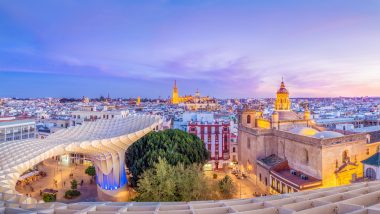
The lively Seville with its art-historical buildings provided the appropriate templates for world-famous opera works such as “Don Juan” or “Carmen”. In addition, the mountains in the hinterland, including the snow-white villages, promise special travel impressions.
The Costa del Sol with its sunshine guarantee is also very popular with holidaymakers, while strong winds blow on the Costa de la Luz that make surfers’ hearts beat faster.
Far from the beaches
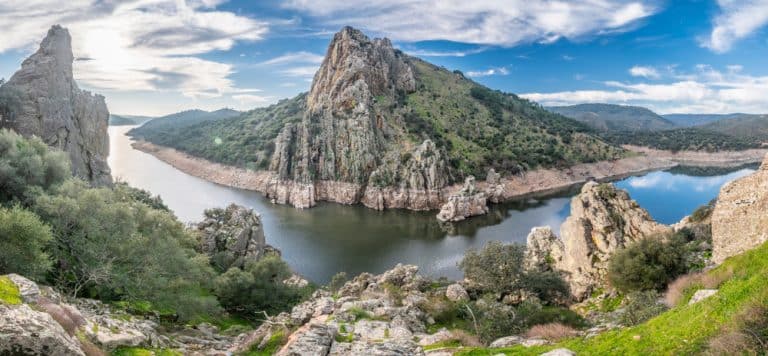
Away from the beaches stretches the sparsely populated Extremadura. Many Spanish conquerors were at home here, who built grandiose cities such as Cáceres or Trujillo after their long journeys, whose stately palaces now function as stone archives of bygone times. Many remains from Roman times testify to the fact that Mérida was once the shining centre of the Roman province of Lusitania. Nature lovers will be amazed by both the unspoiled landscape and the birdlife in the Parque Natural de Monfragüe.
Spain beckons
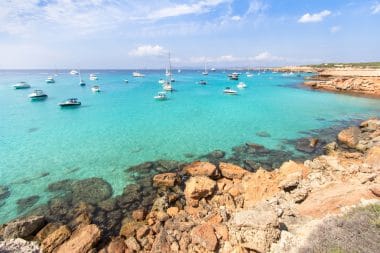
Turquoise blue water at Cala Saona beach on Formentera, Image: D.Bond / shutterstock
The Spanish kingdom is known to have numerous islands in the Atlantic and Mediterranean Seas. They stand for the beauty of nature, relaxation and great holiday fun. The Balearic Islands are among the most popular islands, in addition to Mallorca and Ibiza, Formentera and Menorca are among them. The mild climate with around 300 days of sunshine every year and the beautiful beaches make Spain’s island world a first-class travel destination. The Canary Islands archipelago is located in the azure Atlantic southwest of Morocco and is already part of Africa, both geographically and climatically. In addition to larger islands such as Fuerteventura, Gran Canaria, Lanzarote and Tenerife, the somewhat smaller ones such as La Palma, La Gomera and El Hierro also await holidaymakers seeking relaxation. The Canary Islands are particularly attractive to nature lovers and sports enthusiasts – hikers and surfers in particular enjoy their holidays there.
Whether mainland or islands: the lure of all these charms made Spain one of the most popular travel destinations. The bathing strongholds of the Mediterranean coast are high on the popularity scale. However, if you want to get to know the numerous colourful facets of Spain in more detail, you should also explore the interior, where hospitality is very important and an independent art with numerous treasures, which are sometimes a little further away and want to be found, provide unique impressions.
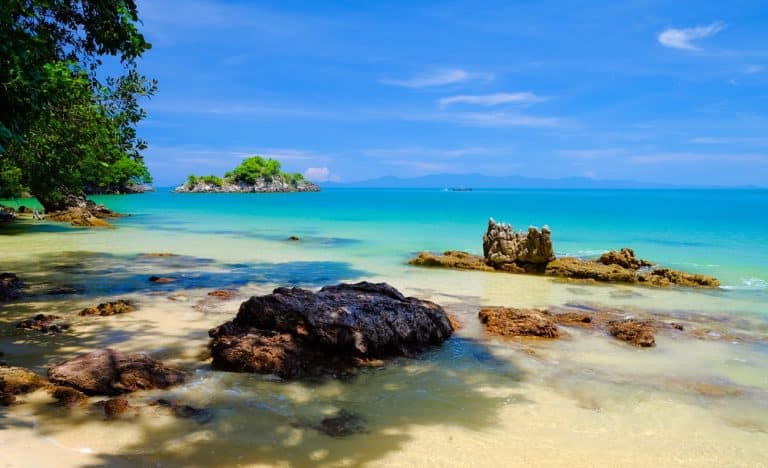
If you think of the island paradises of Thailand, you will certainly develop a lot of passion for the small island of Koh Phayam. Sparsely populated and almost untouched in its very own nature, the island offers a great opportunity for relaxation and a discovery of the special nature of Thailand’s small islands, especially for excursionists. Due to the fact that the island has only become a paradise for holidaymakers in recent years, there are not many historical sights to see here. On the other hand, visitors will find great nature and a variety of opportunities for relaxation and time on the beach.
For many years, the islands of Thailand have had the reputation of being particularly popular with backpackers and travelers who embark on a journey through the world on their own and away from mass tourism. Although there is little infrastructure for tourists on the island, all in all you will find a paradise here, which is still almost untouched compared to the rest of Thailand.
The few accommodations that exist on the island are not connected to a huge hotel complex and all kinds of amenities. They are quite simple bungalows that require minimal equipment and thus fit perfectly into the image of the island. This is also one reason why many of the holidaymakers who discover the island for themselves do so with a day trip and opt for accommodation elsewhere in Thailand.
Since the island also has a rather poorly developed infrastructure, mopeds usually move across the island and connect the two main beaches, Ao Yai and Ao Khao Kwai. This is also where much of life on the island takes place. If you are looking for almost unspoiled and dreamy beaches from the catalogue, you will find the right motifs and the best opportunities for a few hours of relaxation.
What should you have done and seen on the island of Koh Phayam?
Arrival on Koh Phayam, Image: Arkadij Schell / shutterstock
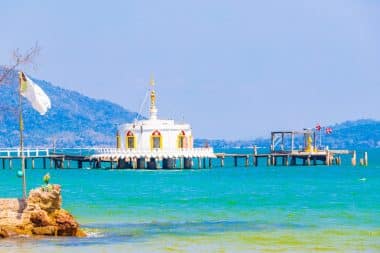
After arriving by boat, the small temple at the pier is particularly striking. Of course, even this small island, which is close to the border with Myanmar , does not come without a worship of the gods. The building, which was built by the inhabitants, has its very own charm and may of course be visited and examined with due respect. From here it goes on to the actual settlements of the island. Those who have decided on a hotel are usually picked up directly and can move into their own bungalow shortly afterwards. For most visitors to Koh Phayam, however, the excursion begins with a visit to the small village of Koh Phayam Village.
This place is almost flatteringly described as “village”, because there are no more than three streets here. A handful of restaurants and a few shops for daily needs form the centre of the village. If you forgot your sunscreen or want to stock up on some drinks or a local soup before the trip to the island center or the beach, you can do it here.
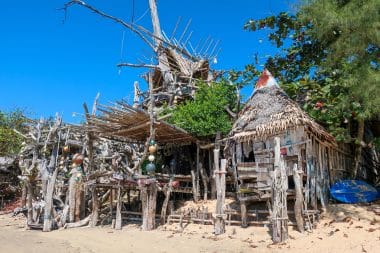
Hippie Bar at Buffalo Bay, built of driven logs, Image: Monique64 / shutterstock
On the island itself, there are actually no other buildings to be found that would have to be considered a special sight. Although many of the holidaymakers have left their own testimonies, especially on the beaches – for example the stone towers or the self-built bar of Buffalo Bay – nature is the attraction here. If you are looking for relaxation, you can opt for one of the many beaches on the island. Here you have to hope for your own luck, because especially in the high season, many visitors are now drawn to the island who want to visit the pristine beaches and laze around a little. If you’re looking for a little more adventure, you can take a tour into the jungle in the core of the island. Corresponding tours are offered both on Koh Phayam and by the providers who also arrange the tours to the island.
Snorkeling, diving and kayaking tours on the island
One thing that makes Koh Phayam so charming is that you can experience and plan your trip on your own. Since there is only a small tourist infrastructure, you usually have to take care of the planning yourself and only get the support of local traders and service providers for some offers. This applies, for example, to the snorkeling tours on the island’s beaches. A little away from the sun worshippers, you can explore the great underwater world of Thailand’s waters. If you don’t like to go underwater, you can take a kayak tour through the mangroves, which have hardly been touched by tourist ambitions so far and therefore offer a very original impression of what the nature of Thailand is like.
All in all, Koh Phayam is something like one of Thailand’s last adventure vacations. No wonder that many backpackers and other adventurers are drawn to the island. If you have the chance, you should decide to visit now. It is almost certain that this island will also be developed more for tourists in the next few years and will thus lose an important part of its original charm
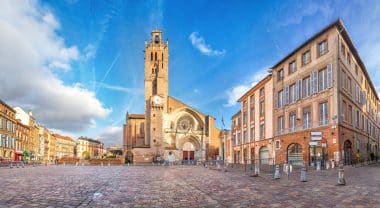
When it comes to fame abroad, Toulouse is somewhat overshadowed by major French cities such as Lyon, Marseille, Paris or Bordeaux. The fourth-largest city in France is not only historically one of the most important cities in the south of France, but also has a long history and a variety of sights to offer. Located deep in the French Languedoc, the Romans have already developed Toulouse into one of the most important cities in Europe. The pink city, as it is called because of the special colour scheme in the bricks of the houses, is now a cultural metropolis and a little insider tip for city trips in Europe.
Even when the Romans ruled over France and gave the area the name Gaul, Toulouse was a city of importance. They developed the city into the center of the province on the border with Spain and for a while all roads in France led not only to Rome, but also to Toulouse. This design can still be seen today. If you walk through the city on your own, you will find Roman street design not only in the materials, but also in the structure of the city center and the old town. Toulouse was a center for the south of France and has remained so to this day.
Toulouse was to retain its special position for centuries, which was also shown by various buildings from the early and late Middle Ages in the city. In the Renaissance, it developed into one of the most important trading cities and also managed to survive the industrialization of France as far as possible. In the modern era, Toulouse was transformed into a city of research, teaching and training. It is not only home to the core of France’s aircraft industry, but also to one of the country’s most important universities and a popular destination for student exchange programs around the world.
Between modernity and history – Toulouse between worlds
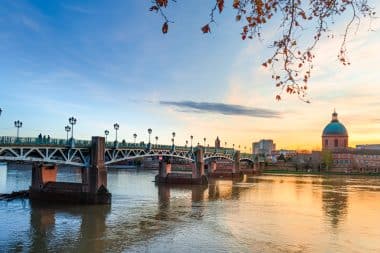
Toulouse is beautifully located directly on the Garonne, Image: MIKISTOCKER / shutterstock
The contrast of the last centuries is clearly evident on a walk through the city. It is not for nothing that Toulouse has earned its reputation as a city of pupils and students. Not only is the average age of young people in the city immediately noticeable, the contrast between the centuries and the generations is also evident in the cityscape. There, a historic church from the Middle Ages and one street down is a testament to the very active graffiti scene in the city, which mixes with street art that can be extremely political.
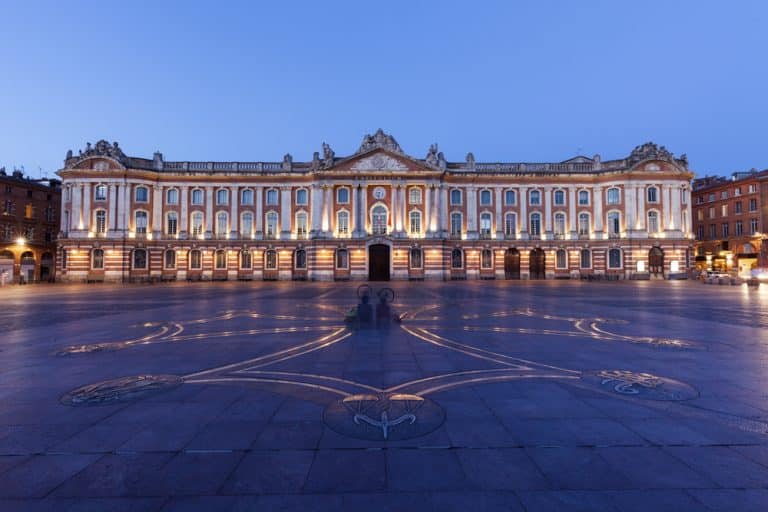
It is noticeable that the sometimes narrow streets, which have their origins in Roman times, merge seamlessly into wide and open squares, which are also a popular meeting place for the inhabitants of the city. The best example of this is certainly the Place du Capitol. The historic town hall from the 16th century and the façade from the 18th century with the huge market square is a testimony to a time when the south of France was ruled by Toulouse and a testimony to the power and prosperity that the city had for many centuries.
If you are looking for historical sights, you should of course also take a look at the many churches that dominate the city skyline. Whether it’s the Gothic cathedral of Saint Etienne or the monastery of Les Jacobins, the church has always played an important role in the history of the city. The Basilica of St. Sernen de Toulouse and Notre-Dame du Taur round off the range of historic church buildings. In addition, many museums and state theaters are located in buildings that were largely built in the Middle Ages or the Renaissance.
But Toulouse is more than a collection of historic buildings. The city is impressively green for its size, which is evident in the many parks and green spaces in the city. The Canal du Midi, which connects Toulouse to the Mediterranean Sea, is a UNESCO World Heritage Site and was an important tool for trade in the city in the past, is also likely to be responsible for this.
Nightlife and culture when visiting Toulouse
In the topics of culture and leisure, the rather young spirit of the city is once again evident. Toulouse has a great nightlife with bars, pubs and restaurants that run through many districts of the city. If you move through the old town and the city center after dark, you will inevitably find many groups of people meeting friends in a restaurant or on their way to the nearest club to turn night into day. Since the various buildings are also particularly illuminated at night, an evening walk can be worthwhile even if you don’t want to wait in a club for the latest hits of the French charts.
A good reason to get an impression of the nightlife for yourself are the many cultural institutions. The theatres offer great performances, the museums are usually open until late in the evening and the young talents of the French poetry slam scene show off on the stages. All in all, there are plenty of opportunities to find a way to end the day after a stroll through the city and how to get an impression of the fresh spirit that animates the city today.
Mauritius offers pure luxury. Long paradisiacal sandy beaches, spectacular nature, luxury hotels and incredibly fascinating cultural sites. The lively cities provide a firework of the senses and relaxation is provided by the soft sand under your feet. The small island state offers tourists a real dream holiday. But what exactly are the most popular destinations on the Indian Ocean island?
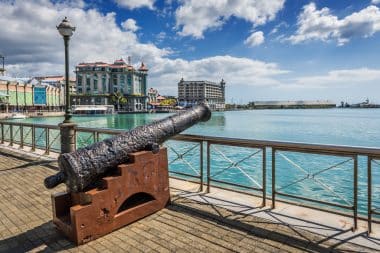
Old cannon on the promenade on the waterfront, Image: Ppictures / shutterstock
The first highlight that tourists encounter in the city is the Marchée Central. This so-called central market of the Moorish city makes tourists’ hearts beat faster. In addition to the most diverse oriental smells, exotic spices, fruit and vegetables offer a magnificent sea of colours. The traders also sell typical clothing as well as jewellery and Moorish souvenirs for loved ones at home. Here you can experience the lively city life and enjoy this unique atmosphere. Many unusual stalls and offers amaze visitors. In addition, Port Louis is not only a cultural but also a spiritual center in the country due to its numerous places of worship. Another highlight is the citadel Fort Adelaide, which sits on a hill and allows a view over the entire city. A panoramic view in a class of its own. An attraction for equestrian sports lovers is the second oldest racecourse in the world, namely the Champ de Mars. Exciting races take place there almost every weekend in the high season. The capital of Mauritius is always worth a visit.
Belle Mare: Fantastic swimming on the east coast
On Belle Mare beach, a very original landscape awaits visitors. On a length of almost 5 kilometers you can enjoy a unique tranquility. Despite the popularity of locals and tourists, the dream beach is never overcrowded. The east coast is definitely one of the island’s insider tips and invites you to really relax your body and soul. Mysterious bays are not only fascinating, but also beautiful places to retreat completely.
Chamarel: The seven-coloured natural phenomenon
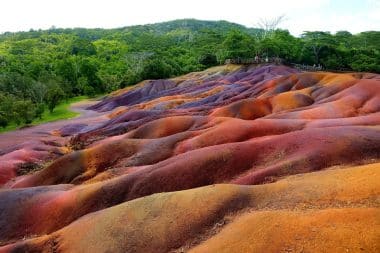
Chamarel, seven coloured earths in Mauritius, Image: MNStudio / shutterstock
One of the biggest attractions for visitors is in the small village of Chamarel. There you can marvel at the seven-coloured, hilly earth, which shines in a wide variety of colours. This natural spectacle is created by a natural transformation of lava into clay minerals, creating nuances such as ochre, yellow, green, red and violet. The best view of the spectacular ground is from the observation deck in the early or late hours of the day, when the sun shines on the natural phenomenon and brings out the colors even more.
Curepipe: The second largest city in Mauritius
The second largest city Curepipe is also the highest city on the island, as it is located at almost 550 meters above sea level. The historic city center stands out especially with its ancient buildings. The old town hall from 1902 and also the Catholic church enchant visitors and take them back to times long past. A city that invites you to dream. Also worth seeing is the volcano aux Cerfs, which is located in the middle of Curepipe. If you feel like it, you can walk up to the crater rim and then have a fabulous view over the island. We descend along a beaten path. An experience that you don’t have every day!
A tropical variety in the Pamplemousses botanical garden
With its fascinating variety of plants, the garden in Mauritius is one of the most beautiful on earth. On a 25-hectare area, spice plants, palm species, plants from the Amazon region and ponds with lotus flowers can be admired. A first-class highlight is the Talipot palm, which only blooms every 60 years. Already at the entrance to the garden, visitors are greeted by a wrought-iron gate. This dates back to the 19th century and was a gift from Francois Liénard de la Mivoie at the time.
Ile aux Cerfs: The small neighboring island
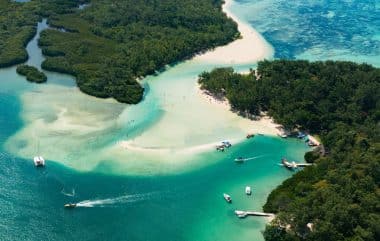
Excursion to the island of Ile aux Cerfs, Image: Karl Ahnee / shutterstock
If you want to make a detour to another island, you can take a boat to the tiny Deer Island next to Mauritius. Ile aux Cerfs is another swimming paradise with fascinating beaches, blue lagoons and the same crystal clear waters. In addition to the tourists, the locals also feel very comfortable here. Water sports enthusiasts also get their money’s worth on Hirschinsel in good wind and weather conditions.
Le Morne Brabant: UNESCO World Heritage Site
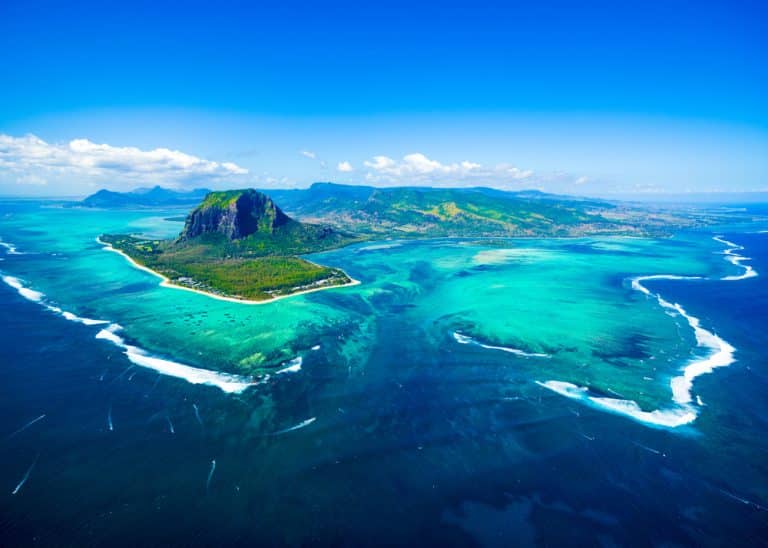
In the southwest of the island, the mountain Le Morne Brabant is waiting to be climbed. The stony path up to the summit is not without its challenges and requires stamina. Once at the top, you will be rewarded by a fabulous panoramic view. If you arrive at the summit in the early hours of the morning, with a little luck and the right timing, you can experience a sunrise that you won’t forget in a hurry. The mountain is part of the UNESCO World Heritage Site and is therefore largely privately owned. For this reason, the mountain can only be climbed with a guide.
Grand Baie: Lively hustle and bustle, action & entertainment
If you have had enough relaxation and want to experience a little more hustle and bustle after restful rest, you can enjoy pure Moorish entertainment in the northwest of the island. In bars and restaurants, especially in the evenings, you can find a good atmosphere and delicious food. Appropriate music and singing by locals take tourists into the culture of Mauritius. This place is full of history and also offers two Hindu temples for the spiritual, Shiv Kalyan, Vath Mandir and Tamil Surya Udaya Samgam. There you can pause for a moment or if you want to meditate.
Rhumerie de Chamarel: The world-famous Rhum Agricole
A tasting of the liquid gold in the rum factory of Mauritius is not to be missed. At the Rhumerie de Chamarel, you can learn from start to finish how the rum is made and taste the quality of the popular rum for yourself. Exciting guided tours in different languages invite you to fully engage with this topic and explore the versatility of production.
The crater lake Grand Bassin: Hindu pilgrimage site and Maha Shivaratri Festival
The Grand Bassin is located directly in a volcanic crater and is the most important pilgrimage site for Hindus outside of India. Numerous temples and statues adorn the landscape. A Shiva statue in the middle of the lake and a huge statue of Durga can be admired. Basically, it is very quiet there most of the year and usually only a few pilgrims can be found. However, in the period from the end of February to March, the holy place is transformed into a colorful festival ground and the so-called Maha Shivaratri Festival of the Hindus takes place. A unique picture that then emerges. A spectacle not to be missed.
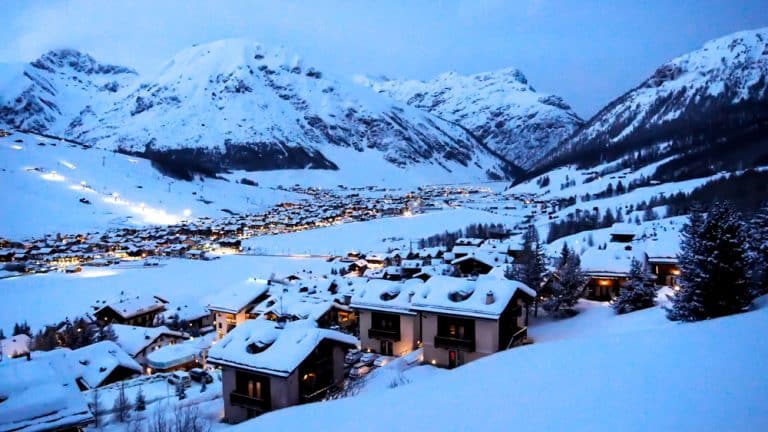
If you want to spend your summer holidays in the mountains, Livigno is one of the ideal destinations. Livigno is part of the mountain municipality of Alta Valtellina, which is made up of 6 municipalities including: Bormio, Sondalo, Valdidentro, Valdisotto and Valfurva. It is the perfect place for mountain lovers and for those who want to relax in the cool air and surrounded by nature at an altitude of about 1800 meters. A typical alpine climate, ideal for those looking to cool off in the hot Italian summers. Livigno and its surroundings offer spectacular views and hikes through ancient alpine pastures that will remain in your memory. You can walk among blueberries and wild strawberries and encounter ibex, deer, chamois and golden eagles along the way. The wonder of the mountains is omnipresent, you just have to discover and experience it in summer.
What do you need to consider for a holiday in Livigno?
As you know, the weather in the mountains can be unpredictable. From one moment to the next, the weather can change and you can experience a day with heavy rain, while the sun was still shining in the morning. In the summer, you’ll need lightweight clothing (such as shorts and T-shirts) that you can pair with heavier, technical clothing.
What should you do in Livigno?
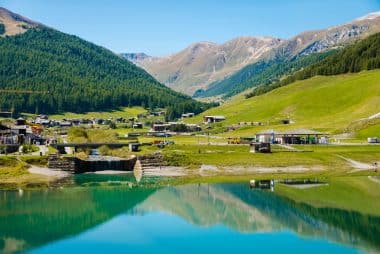
View over Lake Livigno, Image: Sona Kabatova / shutterstock
1. Trekking on the border between Switzerland and Italy:
Boots on your feet, backpack on your back and a packed lunch. The rest is on the path that leads to the summit of Monte Breva (3,014 m), the natural border between Switzerland and Italy. From the start near Malga Campaccio – where you can buy cheese and other alpine products and a sign indicates that the entire area (over 7oo hectares, from 1,950 to 2,800 meters altitude) belongs to the municipality of Bormio – the hike leads along an uphill path that is accessible from the thaw until snow and ice cover it off the maps again. After a two-hour walk and a difference in altitude of about 600 metres, you will reach Lago del Monte, a glacial basin surrounded by high mountains, which will take you to Cima Breva in about three hours and with a difference in altitude of 600 metres. On the way from the valley to the summit, not only the flora and fauna changes, but also the composition of the rocks, which is an unmistakable testimony to the different geological eras and the chaos that arose here at the time of the formation of the Alps.
2. Yoga at 3000 meters: Sunrise detox with wellness brunch:
The memory of the alarm clock ringing before dawn fades at 3000 meters above sea level as you immerse yourself in the silence of the majestic Alpine peaks. In the morning fog, on a day waiting for the beginning of the sunrise. The meeting point is the Ristoro Carosello 3000 at about 6.30 am. The cable car deliberately opens at 6:00 a.m. on Tuesdays so that participants can reach the hut. The experience consists of a slow hike to the Madonon, one of the most panoramic points of the entire Livigno Valley. Along the way, some breaks are made at particularly spectacular points dedicated to exercise and meditation. Stop near the alpine lake Lac Salin, on a rocky outcrop overlooking the cantonal valley and then in a clearing overlooking the Bernina massif. Under the guidance of the teacher, one greets the sun, performs pranayama (controlled breathing exercises) and simple asanas (postures) in front of the immovable sight of the mountain and the rising sun, which warms the temperature and ushers in the new day. The experience lasts about three hours; it is at the same time devotion and self-discovery, relaxation and listening. Upon arrival on Madonon, the meditation session will be followed by a tasting of aromatic herbal teas. On the way back, a hearty wellness brunch awaits the participants at the Ristoro Carosello 3000.
3. Downhill, flow trails and adrenaline-pumping mountain bike trails:
Livigno is mountain bike friendly. The proof? It has more than 3,200 kilometres of GPS-surveyed routes, professional MTB guides and instructors for freeride, downhill and cross country, as well as service stations along the cycle path and various bike rentals. There are also ski lifts to reach the highest peaks, as well as bike hotels and specialty shops with everything a biker needs. Livigno’s love for mountain biking began with downhill biking and the creation of the Mottolino Bike Park: 14 routes (served by a gondola, so everything downhill) full of parabolas, drop and table jumps, walkways and wall rides, perfect for freeriding. The real passion then ignited with the inauguration of the Flow Trails Coast to Coast and Roller Coaster on the Carosello 3000 side – which translates as roller coaster for mountain bikes. They are not steep and rugged paths, but gentle paths where you can let your bike run in a continuous succession of curves, parabolas, bumps and rhythmic sprints. In short: fast, adrenaline-filled routes suitable for everyone.
Those who fly to the archipelago of the Azores , which is part of Portugal, usually visit several islands. Under no circumstances should you miss the almost 234 square kilometre island of São Jorge, which would be called Saint George in English. Once upon a time, apart from local guests, it was mainly surfers who got lost here. This is no wonder, because São Jorge has breathtaking cliffs where rough waves crash. For experienced surfers, the island’s beaches continue to be a true paradise. In the meantime, hikers and nature lovers are also attracted to São Jorge. There are some exciting volcanoes to climb. In addition, São Jorge captivates with enchanted-looking mountain villages, some of which can only be reached on foot even in the 21st century. The ideal place for all those who want a mixture of relaxing idleness and an active holiday in the best climatic conditions.
As in the other Azores islands, São Jorge has a subtropical oceanic climate that always remains stable. The seasons blur here and a difference between summer and winter is hardly noticeable. Between June and October, temperatures reach around 25 degrees. In winter, they hardly fall below 17 degrees. However, since rough winds blowing from the Atlantic are to be expected, storms can occur in winter that thwart one or the other hiking adventure. So if you want to be on the safe side in terms of weather, visit São Jorge between spring and autumn. Then the beaches of the island also invite you to swim without having to fear heat stroke.
A visit to the island’s capital Velas
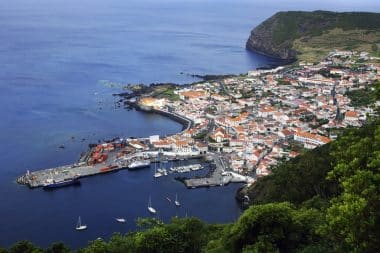
The island’s capital Velas, Image: Henri Faure / shutterstock
The island’s capital, Velas, is located in the southwest of the 53.5-kilometre-long island. With almost 2,000 inhabitants, almost a quarter of the island’s population lives here. Velas is the administrative center of São Jorge, but it seems clear and a little sleepy. You don’t need a car here, because due to the tight dimensions of the city, everything is within easy walking distance. The town centre is formed by stately buildings in the Portuguese style. Visitors often reach the island of São Jorge at the ferry port of Velas. From there you walk directly to the Igreja Matriz de Velas church on the main square.
There is also the Museu de Arte Sacra, which deals with local church art. Outside the town centre, the Piscina Natural da Poço dos Frades is well worth seeing. This is a naturally formed rock arch directly by the sea. If you then climb the Miradouro das Velas viewpoint, you have a wonderful view of Velas and the sun rising or setting over the Atlantic, especially in the morning or evening hours. Romantic hours are guaranteed here.
The Fajãs of São Jorge
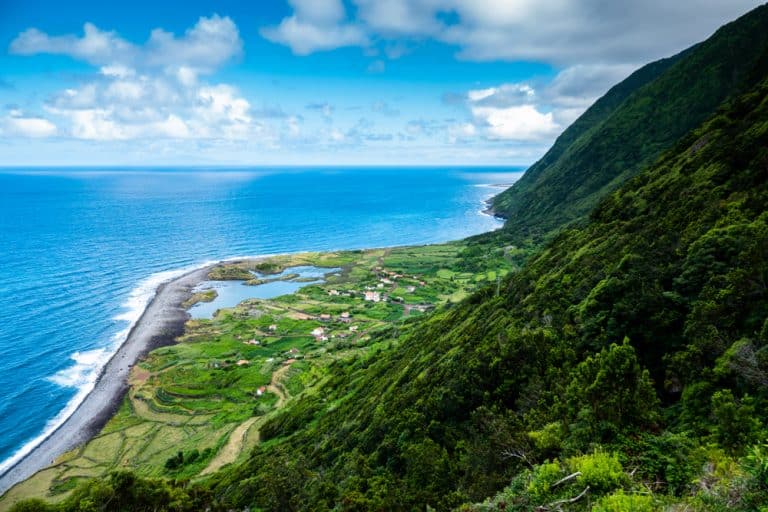
The fajãs of São Jorge are unique. Fajãs are fertile coastal plains that owe their existence to previous lava flows or landslides. The island has about 75 fajãs to date. Fajãs are characteristically difficult to access and are often a little hidden. But that’s exactly what makes them perfect hiking destinations. The locals have used the fertile fajãs since time immemorial to grow crops, coffee, oranges or bananas. Sometimes only one family settled near a fajã, sometimes a small village was built there.
Many fajãs are still farmed today, although the younger generation is increasingly turning their backs on the arduous life of the fajãs farmers. So if you want to gain an insight into traditional life on São Jorge, you should definitely visit some of the Fajãs on foot. The views from the edges of the Fajãs are also spectacular, as they are located near the cliffs of the island.
Hiking on the Grand Route of São Jorge and other trails
Faja da Caldeira de Santo Cristo, Image: Karol Kozlowski / shutterstock
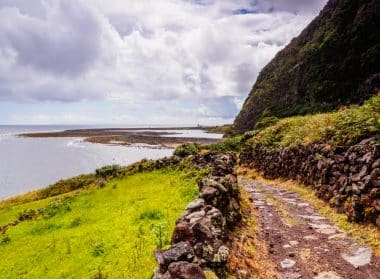
If you want to make a real hiking holiday out of your stay on São Jorge, you can actually hike half the island on the Great Route of São Jorge, over a distance of 41.5 kilometers. The well-flagged hiking route is considered challenging and can be completed in two or three days – depending on your pace and fitness level. On the way, it goes up and down constantly, up to the 1,053-meter-high Pico da Esperança, which is the highest mountain on the island. Like all of São Jorge, it is of volcanic origin. When the weather is nice, the surrounding Azores islands of Pico, Faial and Graciosa can be seen from the crater top of Pico da Esperança. Alternatively, you can also reach Pico da Esperança via several other hiking trails. The ascent to the 1,019-metre-high Morro Pelado is also worthwhile.
A sea of leisure activities
Tourists who don’t like hiking, or simply want a little variety, can also explore the volcanic island by mountain bike. There are numerous routes of all levels of difficulty. Around Urzelina, climbing enthusiasts meet in a natural rocky landscape. Near the towns of Montoso and Bocas do Fogo, speleologists get their money’s worth. In addition, a lot of different bird species settle on the island, which you can constantly encounter during all activities. Thus, São Jorge is the perfect holiday destination for all bird lovers. After all the efforts, you should enjoy the culinary delights of the island. The freshly caught seafood and locally grown coffee are outstanding. In addition, São Jorge is famous for its cheese, which is produced in many variations.