











Explore Hue, Vietnam’s imperial capital. Discover the UNESCO Citadel, royal tombs of Tu Duc and Khai Dinh, Perfume River cruises, and local food culture.
Hue is the former imperial capital of Vietnam, and almost everything worth seeing sits along a slow green waterway called the Perfume River. The Hue Imperial City Vietnam travelers come to see is the country’s first UNESCO World Heritage Site: a walled citadel of palaces, gates, and royal tombs built by the Nguyen Dynasty between 1802 and 1945. This guide covers the citadel, the tombs, the river, the food, and how to reach Hue from Da Nang and Hoi An.
The city rewards travelers who slow down. Morning light on moss-covered gates, a boat drifting past Thien Mu Pagoda, a bowl of bun bo Hue eaten at a riverside stall: these are the moments that linger longer than any single monument.
Why Is the Hue Imperial City Vietnam’s Royal Heart?
Hue served as the seat of thirteen Nguyen emperors from 1802 to 1945, and the Complex of Hue Monuments was inscribed as Vietnam’s first UNESCO World Heritage Site in 1993 (, 1993). The Nguyen rulers chose the site for its river, its surrounding hills, and its alignment with geomantic principles meant to protect the dynasty.
Walking the grounds, you feel how deliberately the capital was laid out. The river runs through the center, the citadel sits on the north bank, and the royal tombs spread into the countryside to the south. Everything points back to the emperor.
The dynasty ended in 1945 when the last emperor, Bao Dai, abdicated. War later damaged much of the complex, which makes the surviving structures all the more striking.
What Can You See Inside the Imperial Citadel?

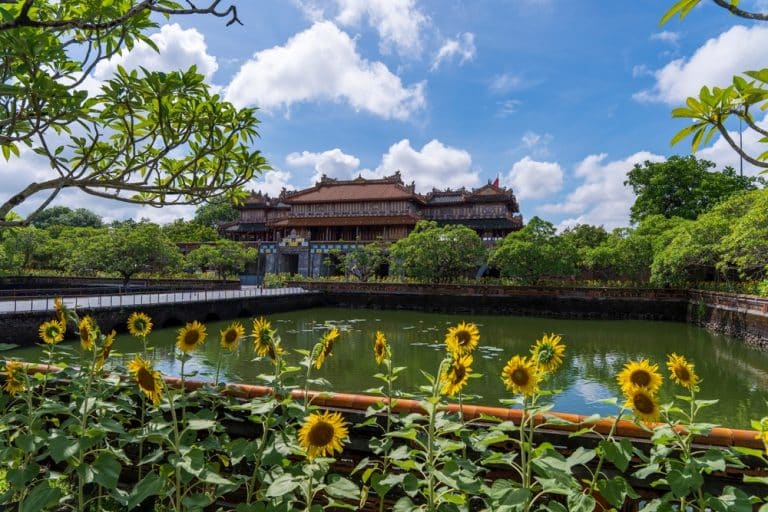
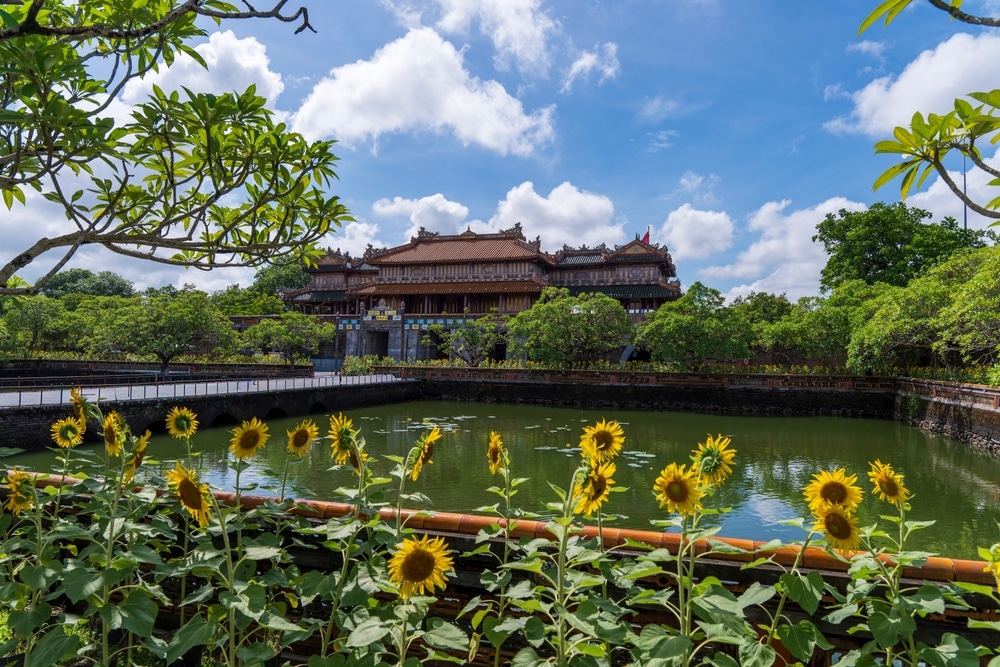
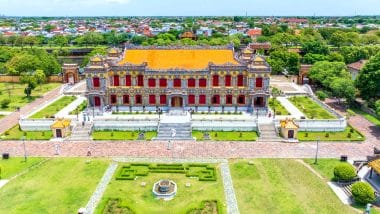
The Imperial Citadel, known as Dai Noi, is a fortified square ringed by thick walls and a wide moat, with the Forbidden Purple City at its core. Enter through the Meridian Gate, the grand southern entrance once reserved for the emperor, and you step into a sequence of courtyards, ceremonial halls, and gardens.
The Thai Hoa Palace, or Hall of Supreme Harmony, held the throne. Beyond it lay the Forbidden Purple City, the private royal residence where only the emperor, his family, and attendants could enter. Much of this inner zone was destroyed, so today you walk among foundations, restored pavilions, and quiet lawns.
Give yourself two to three hours here. The citadel is large, the sun is strong, and the detail in the surviving woodwork and tilework rewards a slow pace.
Which Royal Tombs in Hue Should You Visit?
Seven Nguyen royal tombs survive in the hills south of Hue, and three stand out for most visitors: Tu Duc, Minh Mang, and Khai Dinh. Each reflects the personality of the emperor who built it, so visiting two or three gives you a fuller sense of the dynasty than any single stop.
Tu Duc’s tomb is the most poetic. The emperor used it as a retreat during his life, writing verse beside a lotus lake framed by frangipani trees. It feels less like a grave and more like a private garden.
Minh Mang’s tomb is the most symmetrical, a formal procession of courtyards, pavilions, and bridges arranged along a single axis amid pine forest. Khai Dinh’s tomb is the most ornate, a steep hillside structure where the interiors glitter with glass and ceramic mosaic. The contrast between Minh Mang’s restraint and Khai Dinh’s dazzle is the reason to see both.
The tombs lie several kilometers apart in the countryside, so pairing them with a private driver or curated makes the most of a half day without fighting midday tour buses.
How Does the Perfume River Connect Hue’s Sacred Sites?
The Perfume River, called Song Huong in Vietnamese, flows about 30 kilometers from its mountain confluence to the sea, threading past Hue’s citadel, pagodas, and tombs (, 1993). A dragon boat trip is the classic way to experience it, and the slow pace matches the city.
The signature stop is Thien Mu Pagoda, a seven-story tower rising on a bluff above the north bank. Built in the seventeenth century, it is one of the oldest and most photographed religious sites in Hue, and its octagonal tiers are a symbol of the city itself.
Many boats continue toward the tombs or simply drift while you watch sampans and herons pass. Go early. Morning water is calm, light is soft, and heat has not yet settled over the valley.
What Makes Hue’s Food and Court Culture Unique?
Hue has the most distinctive cuisine in Vietnam, shaped by centuries of imperial kitchens that turned royal banquets into an art form. The city’s signature dish, bun bo Hue, is a spicy lemongrass beef noodle soup richer and more fragrant than standard pho.
Imperial banquet dining still exists in Hue, with small, carefully plated courses modeled on dishes once served to emperors. It is theatrical and pairs naturally with an evening of royal court music.
That music, Nha Nhac, was recognized by UNESCO as Intangible Cultural Heritage of Humanity in 2003 (, 2003). Performed for ceremonies and royal events, it was once reserved for the court. Hearing it on a boat or in a restored pavilion connects you directly to the dynasty that built the city.
How Do You Plan a Trip to Hue?
The best months to visit Hue are February through April, when weather is dry and mild. The rainy season runs September to December; heavy rain can raise the Perfume River and interrupt boat trips, so schedule river time and tomb visits for morning hours.
Most travelers reach Hue from the south. Da Nang International Airport is the nearest hub, roughly two hours away across the dramatic Hai Van Pass. From Hoi An, the drive takes three to four hours by private car. A scenic transfer lets you stop at Lang Co beach, the Hai Van Pass summit, and the Marble Mountains. Scenic coastal trains also run this corridor.
Hue rewards travelers who structure their days thoughtfully. Whether exploring independently by train or arranging private transfers through regional specialists like , taking an unhurried approach across the Hai Van Pass is what turns Hue from a quick transit stop into the cultural highlight of Central Vietnam.